
When we experience a major crisis, we are often focused on immediate needs for ourselves and for those we are caring for. There is a “panic” reaction that causes us to make sudden adjustments. Many of us have had to make such quick, painful adjustments over the last few weeks as we faced the realities of COVID-19.
Leaders need to be aware of the emotional changes happening internally as we make rapid adjustments affecting many lives (including our own). “During challenging times, leaders know self-care and team care are of utmost importance,” said Rob Peters, former pastor and founder of Corpus Vitae, a church revitalization ministry. “If you or your team members become burned out, spent, or overwhelmed, you will be no good to the others you serve.”
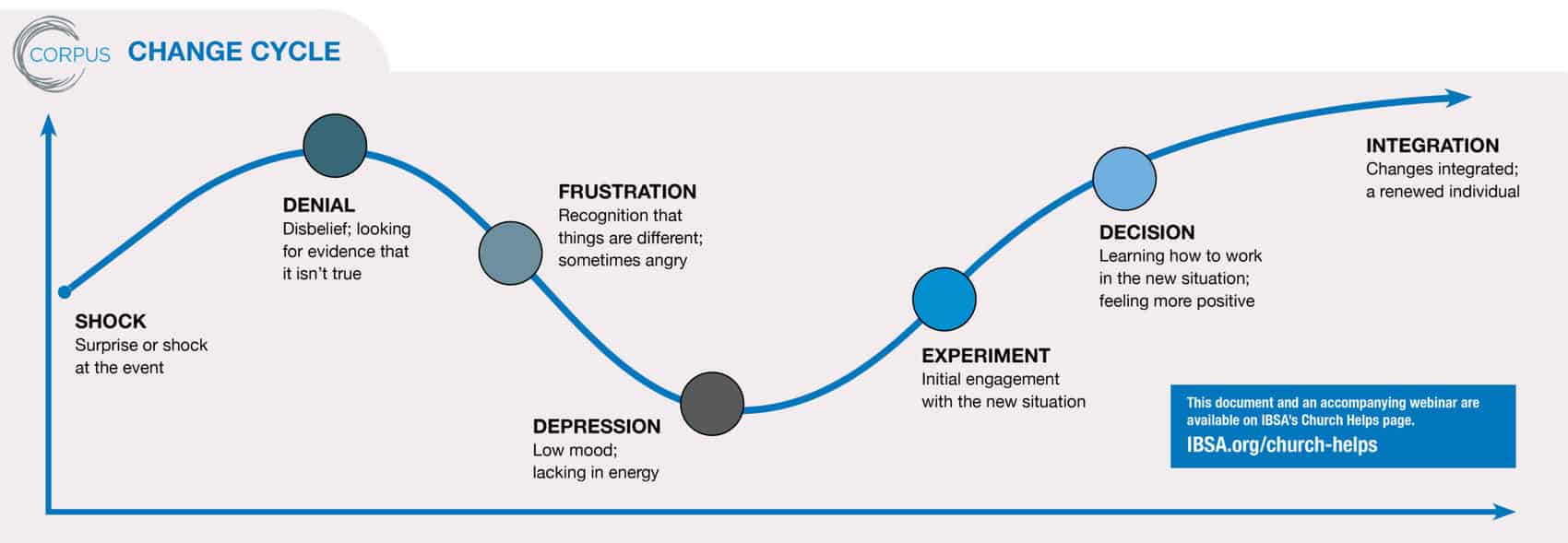
Peters cites the Kubler-Ross change curve to understand the stages of emotion a person experiences when they process a traumatic event, such as the death of a loved one. The stages of emotion captured by Kubler and Ross, often referred to as the grief cycle, can also be applied to leaders responding to the rapid developments related to the COVID-19 pandemic.
“The change curve is a popular and powerful model used to understand the stages of personal transition and organizational change,” Peters says. “It helps you to anticipate how people will react to change, so that you can provide what they need to make their own personal transitions. And you can make sure they have the help and support they need through the crisis.”
Peters encourages every leader to take time with a trusted friend to assess where they are in the stages of emotional change. Then you can develop a plan to move forward into the experiment, decision, and integration stages of the change curve.
“When you learn to work in the new circumstances of your situation, you begin to feel more positive,” Peters said. “God then uses the adjustments you’ve made in your life and ministry to help you to emerge from the challenging circumstances as a renewed, growing individual. These positive changes can also translate across the entire ministry team you lead.”
Through his church consulting and revitalization ministry, Peters has developed and released a free resource, ReThink, that is available to all IBSA leaders free of charge. Plus, he led a webinar on the topic for IBSA’s Church Helps series.
Scott Foshie is IBSA’s revitalization director.